
Why study this course with LJMU?
- LJMU ranked 2nd in the UK for health professions courses (The Guardian University Guide 2025)
- LJMU ranked 11th in the UK for paramedic science (The Guardian University Guide 2025)
- A wide range of quality placement opportunities
- A programme delivered by HCPC registered paramedics
- Supported in a multi professional learning environment
- Excellent supervision and support in practice settings
- Evidenced based education and learning
- £5,000 per year NHS training grant, plus another £2,000 for students with dependent children (eligibility criteria apply)
Please note: This course is currently not accepting new applications for September 2025 entry.
About your course
BSc (Hons) Paramedic Science at Liverpool John Moores University gives you the opportunity to acquire the knowledge, skills and confidence required to become a registered paramedic. You will achieve the high standard expected of today’s health professionals, enabling you to work effectively at the frontline.
Working alongside other health professionals and emergency services, you will develop strong leadership skills and the ability to work independently, as well as being a member of a team. A good level of physical fitness is paramount as moving and handling of patients and equipment is part of the role.
Your placements will be in the most part with North West Ambulance NHS Trust (NWAS). They are the largest ambulance service outside London, providing emergency care for 7 million people across the region and responding to 952,000 calls each year.
As you progress under supervision, you will be challenged to adapt quickly as situations change. The course will help you develop the clinical skills, underpinning knowledge and interpersonal skills you need to care for people in distressing circumstances. Ultimately, you will have the confidence to work effectively and independently.
We utilise many practice areas within the Merseyside and Cheshire area, which include NWAS, accident and emergency departments, health centres, hospital operating theatres, maternity units, paediatric facilities, mental health facilities and critical care facilities. Each of these placements will add to your experience and development as a paramedic student.
We have excellent facilities within the university so that we can offer you simulated experiences to support your practice. You will benefit from multi-professional days when you will be working alongside and learning with midwifery and nursing students.
See our students competing in the annual Paramedic Games.
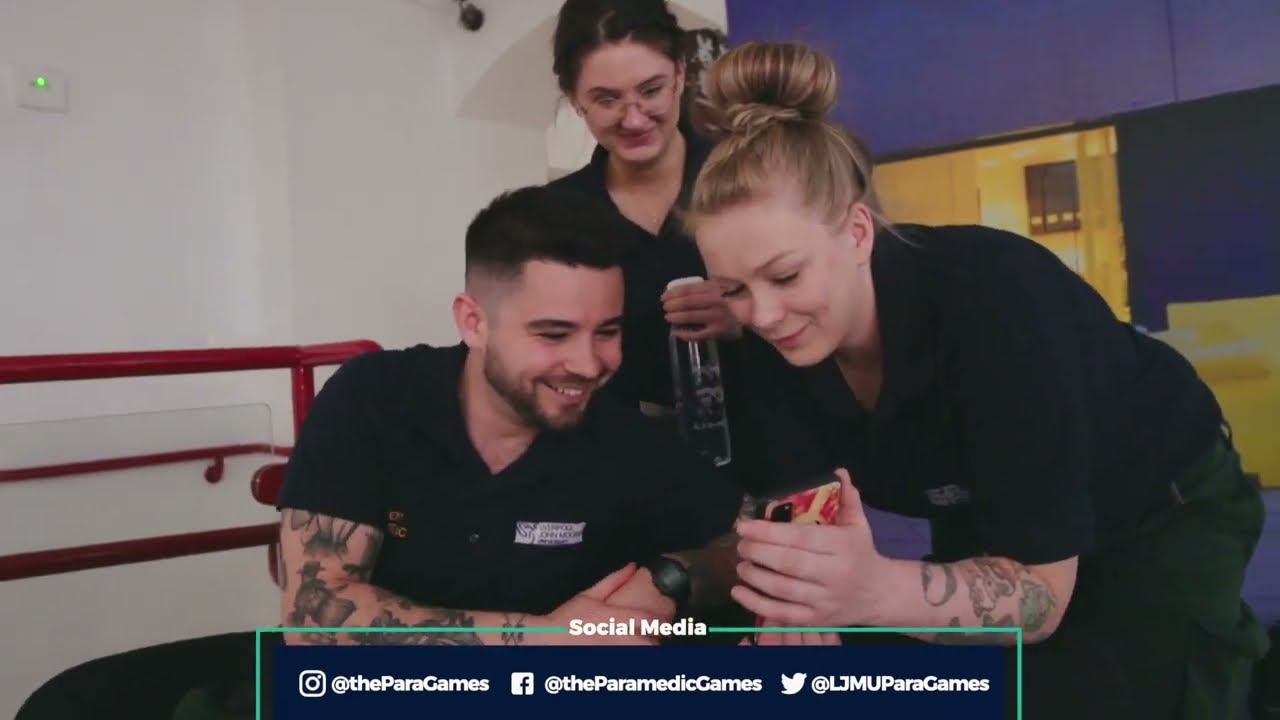
See our students competing in the annual Paramedic Games.
Hear our paramedic students describe why they love studying at LJMU

Hear our paramedic students describe why they love studying at LJMU
Course modules
What you will study on this degree
You will complete modules to a total of 120 credits at each level of your degree. All modules are 'Core'; this means all students on the degree will study them.
Levels 4 and 5 are both split 50:50 between theory and practice. At Level 6 there's more of an emphasis on practice with a 40:60 split, helping to prepare you for employment as a paramedic. Increased practice-based placements will allow for a greater depth of service user medical assessment in primary care settings.
Reflective Practice
Reflecting on your own and and fellow student paramedics' simulated clinical practice is a great way to help you develop skills, build confidence and prepare for real-world placements. To do this in the best way possible, we have invested in state-of-the-art recording equipment in each of our clinical practice suites and other teaching spaces. During specific modules, you will be asked to take part in the filming of both yourself and other students. The footage recorded is strictly confidential and must not be shared inappropriately or released into the public domain. Being professional and having respect for others must always be maintained. This strict confidentiality ensures you can be at ease and fully engage with your teaching and learning experiences. Each patient bay is equipped with two cameras and a microphone so you can record yourself completing a procedure - say practicing cannulation skills or wound dressing - and then watch it back to see how you did, spotting good practice or any areas for improvement. It's truly a transformative way to learn and hone your skills!
This course is currently undergoing its scheduled programme review, which may impact the advertised modules. Programme review is a standard part of the university 's approach to quality assurance and enhancement, enabling us to ensure that our courses remain up to date and maintain their high standard and relevancy.
Once the review is completed, this course website page will be updated to reflect any approved changes to the advertised course. These approved changes will also be communicated to those who apply for the course to ensure they wish to proceed with their application.
Further guidance on modules
Modules are designated core or optional in accordance with professional body requirements, as applicable, and LJMU’s Academic Framework Regulations. Whilst you are required to study core modules, optional modules provide you with an element of choice. Their availability may vary and will be subject to meeting minimum student numbers.
Where changes to modules are necessary these will be communicated as appropriate.
Core modules
Contextual Studies 1
20 credits
20 credits
Creative Enterprise 1
20 credits
20 credits
Production & Performance 1
10 credits
10 credits
Dance Technique 1
20 credits
20 credits
Performance Skills 1
20 credits
20 credits
Choreography 1
10 credits
10 credits
Commercial Dance Styles 1
20 credits
20 credits
Core modules
Creative Enterprise 2 Commercial Dance
10 credits
10 credits
Performance Skills 2
20 credits
20 credits
Dance Technique 2
20 credits
20 credits
Commercial Dance Styles 2
20 credits
20 credits
Aerial Skills 1
10 credits
10 credits
Contextual Studies 2
20 credits
20 credits
Production and Performance 2
20 credits
20 credits
Core modules
Creative Enterprise 3
20 credits
20 credits
Research Project
20 credits
20 credits
Dance Technique 3
10 credits
10 credits
Production & Performance 3
40 credits
40 credits
Commercial Dance Styles 3
20 credits
20 credits
Aerial Skills 2
10 credits
10 credits
Your Learning Experience
Excellent facilities and learning resources
We adopt an active blended learning approach, meaning you will experience a combination of face-to-face and online learning during your time at LJMU. This enables you to experience a rich and diverse learning experience and engage fully with your studies. Our approach ensures that you can easily access support from your personal tutor, either by meeting them on-campus or via a video call to suit your needs.
We deliver our modules in a variety of methods. We appreciate that students learn in differing ways and we have the experience and understanding to support each individual through the programme.
Work-related Learning
The wide range of placements coupled with the evidence-based learning will offer you a unique insight into the profession of the paramedic. By designing your programme in this innovative way, we are confident that you will successfully develop your skills, knowledge and professionalism as you move closer to the point of registration with the Health and Care Professions Council.
Dedicated personal tutor, plus study skills support
In addition, you will be allocated a Personal Tutor at LJMU, who will give you feedback on how you are progressing with your studies and help you to plan for your educational and career development. The university also offer wider support for all of our students if needed.
Assessment varies depending on the modules you choose, but will usually include a combination of exams and coursework.
Your marks and feedback will be available within 15 working days of submitting a piece of work. That's because we believe that constructive feedback is vital in helping you identify your strengths as well as the areas where you may need to develop further.
Where you will study
Part of the City Campus, the School of Public and Allied Health works with a wide range of health and social care organisations to design and deliver a dynamic suite of courses. In addition to clinical practice suite facilities, we have two full size specialist ambulance suites. You will also find high quality seminar rooms, IT suites and lecture theatres, plus a café and social spaces. The School's flagship Tithebarn Building adjoins the Avril Robarts Library.
Course tutors

Jason works as part of an amazing group of senior lecturers who form the Paramedic Team at LJMU. He began his career with the former Greater Manchester Ambulance Service (GMAS) in 2000, qualifying as a paramedic in 2001. Since then, he has progressed through the roles of Clinical Practice Trainer and IHCD Paramedic Instructor with GMAS, before the North West Ambulance Service Merger in 2006. Following this, Jason moved to an Advanced Paramedic clinical position within NWAS, managing a team of Senior Paramedics, providing clinical leadership and support to this team and to paramedics and Emergency Medical Technicians.
I enjoy seeing the passion, enthusiasm and caring qualities in our students. I particularly enjoy seeing the development of each paramedic student throughout their education and clinical experience in university and in practice, and I appreciate that every student has a unique journey through the programme. As every paramedic student walks across the stage at graduation each footstep reminds me of their student story.


As a student from Northern Ireland, paramedic science wasn't a course that I could do, as no universities offered it. As a result, I looked over to England and Scotland for paramedic courses. Finally, I found Liverpool John Moores and instantly fell in love.
Career paths
Once completing the programme, you will be eligible to apply for registration with the Health and Care Professions Council. This registration will allow you to practice anywhere in the UK as a paramedic.
Once you are a qualified paramedic and you start to build your experience, you can begin to consider progression within your chosen healthcare setting, weather that is with an ambulance service, primary care setting or any other form of NHS Trust or private organisation. You can also develop wider skills and educational pathways, which would support your future development.
The College of Paramedics offers advice and guidance on career and professional development and as a team we will be guiding and advising you.
Student Futures - Careers, Employability and Enterprise Service
A wide range of opportunities and support is available to you, within and beyond your course, to ensure our students experience a transformation in their career trajectory. Every undergraduate curriculum includes Future Focus during Level 4, an e-learning resource and workshop designed to help you to develop your talents, passion and purpose.
Every student has access to Careers Zone 24/7, LJMU's suite of online Apps, resources and jobs board via the LJMU Student Futures website.
Tuition fees and funding
Fees
The fees quoted above cover registration, tuition, supervision, assessment and examinations as well as library membership and student IT support with access to printed, multimedia and digital resources including programme-appropriate software and on campus Wi-Fi.
Financial Support
The University offers a range of scholarships to support students through their studies. You'll find all the information you need on our specialist funding pages, including details of the Student Support Fund and other activities to support with the cost of living.
Additional Costs
In addition to fees, students should also keep in mind the cost of:
- Accommodation
- Travel costs including those for placements, visas and travel for studying abroad and field trips unless paid for by LJMU
- Stationery, IT equipment, professional body membership and graduation gown hire
The University reserves the right to increase tuition fees in accordance with any changes to the maximum allowable fees set by the UK Parliament. In the event of such a change, any fee increase will be subject to a maximum cap of 10% of the total course cost as originally stated at the time of your offer.
- You may incur additional costs for travel to placement and parking. Reimbursement for this has not yet been identified or agreed.
- Students who would like to buy extra uniform items, further to their standard uniform which is included in the course fees, have the option to do so.
Not covered as part of the course or included in course fees:
- Provisional driving licence
- C1 Class driving licence training and test
Please read the driving licence information on the Entry Requirements tab. You can read more about the C1 licence requirement in the Frequently Asked Questions (FAQ) section on the College of Paramedics website.
Entry requirements
Please choose your qualifications below to view requirements
Grades/points required from qualifications:
Work out how many UCAS points your qualifications are worth by visiting the UCAS Tariff Calculator.
Qualification requirements
A levels
Minimum 104 Tariff points A/AS Level excluding General Studies
BTECs
including a Distinction and Merit profile
International Baccalaureate
Minimum 24 points including 6 in English at a Higher Level
Alternative qualifications considered
Applications will also be considered from students who have successfully completed and passed the IAB Foundation in Dance programme
Alternative qualifications considered
All students complete a written application and are practically auditioned by a process which enables the audition panel to assess prospective student´s abilities in a number of the core dance techniques key to the programme. This is followed by a one-to-one interview with the Programme Leader or another member of the programme team. Within the interview their academic knowledge of and interest in the subject area are explored. Their language skills and capacity to successfully complete the programme will be evaluated. The key attributes that are looked for are: Knowledge, ability and experience Technical and creative potential in practical skills Musicality and rhythmic understanding A level of physicality and fitness to be able to cope with the demands of the programme Enthusiasm, broad interest and engagement with the audition and subject area Ability to work effectively with others Self-awareness and determination to succeed GCSE English Language at grade 4 or above or, an IELTs 6.0 or equivalent SELT score is a requirement for entry to the programme. Equal Opportunity IAB is an equal opportunities organisation and aims to successfully recruit globally based students from a wide range of different socio-economic and personal backgrounds. We recognise and celebrate diversity in our academic community. Recognition of prior (Experiential Learning (RP(E)L) and credit transfer Evidence of prior successful completion of a complete level of study may be considered for direct entry to levels 5 or 6. You are required to complete an application, provide the evidence and where equivalence can be confirmed and is supported by the IAB, your request will be submitted to LJMU for their consideration and potential approval.
International requirements
Other international requirements
The national university entry academic qualification of your country equivalent to 104 UK Tariff points or 24 points from an international Baccalaureate. We welcome applicants with qualifications from outside of the UK.
How to apply
Securing your place at LJMU
UCAS is the official application route for our full-time undergraduate courses. Further information on the UCAS application process can be found here https://www.ljmu.ac.uk/study/undergraduate-students/how-to-apply.
Your university life
From accommodation and academic support to clubs and societies. Find out what LJMU has to offer.
Related Links


Talk to our students
Connect with a current LJMU student for advice and guidance on university life, courses and more.
See what our students are saying
At LJMU we want you to know you're making the right choice by studying with us. You can see what our students are saying about their experience with us through their reviews on the following websites:


News and views
Browse through the latest news and stories from the university

The university reserves the right to withdraw or make alterations to a course and facilities if necessary; this may be because such changes are deemed to be beneficial to students, are minor in nature and unlikely to impact negatively upon students or become necessary due to circumstances beyond the control of the university. Where this does happen, the university operates a policy of consultation, advice and support to all enrolled students affected by the proposed change to their course or module.
Further information on the terms and conditions of any offer made, our admissions policy and the complaints and appeals process.