
Why study this course with LJMU?
- Excellent student support from academic tutors, technical staff and student mentors in both practical and academic activities throughout all levels of study
- Professionally-accredited, design-led engineering curriculum emphasises developing understanding through application
- Teaching is supported by well-equipped laboratories and workshops with state-of-the-art software and excellent technical support
- Professional engineers regularly contribute to courses, and industrial visits provide insights into careers in professional engineering and you also have the option of completing an industrial placement
- The foundation year allows progression to our BEng Marine and Mechanical Engineering programme which is Accredited by the Institution of Mechanical Engineers and approved by the Maritime and Coastguard Agency, giving exemption from theoretical components of the Engineering Officer of the Watch (EOOW) professional qualifications, up to and including the level of Chief Engineer
About your course
The BEng (Hons) Marine and Mechanical Engineering and with Foundation Year at Liverpool John Moores University is the ideal course if you are interested in this subject but lack the necessary qualifications to study it at degree level.
About the Foundation Year
The Foundation Year is ideal if you have the ability to study for a degree but dont have the qualifications to enter directly onto the Mechanical and Marine Engineering honours degree programme. Once you pass the Foundation Year you will progress directly onto the first year of the honours degree. If you are a full-time UK student, you will qualify for student financial support for the full duration of your course (subject to eligibility criteria).
About the BEng (Hons) Mechanical and Marine Engineering degree
This degree will give you an in-depth understanding of the scientific principles and advanced design technology as well as the problem solving and management skills required to be a successful marine engineer.
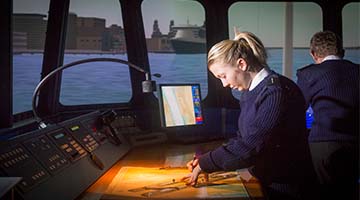
This is one of the UKs leading engineering schools, with a supportive staff team and excellent facilities including engine test facilities, full marine engine room and bridge simulators, materials testing laboratories and digital design studios, which you have full use of in practical sessions. Links with national and international companies such as Bibby Line, Rolls Royce, Shell and Castrol mean that the course is tailored to the needs of employers and, as an extension of this, we offer you the opportunity to undertake a years paid placement in industry.
Course modules
What you will study on this degree
Further guidance on modules
Modules are designated core or optional in accordance with professional body requirements, as applicable, and LJMU’s Academic Framework Regulations. Whilst you are required to study core modules, optional modules provide you with an element of choice. Their availability may vary and will be subject to meeting minimum student numbers.
Where changes to modules are necessary these will be communicated as appropriate.
Core modules
Project Study
20 credits
20 credits
Foundation Mathematics for Engineering and Technology 1
20 credits
20 credits
Foundation Mathematics for Engineering and Technology 2
20 credits
20 credits
Introductory Foundation Physics
20 credits
20 credits
Academic English Skills 1
20 credits
20 credits
Academic English Skills 2
20 credits
20 credits
Core modules
Engineering Mathematics I
20 credits
20 credits
Surveying and CAD
20 credits
20 credits
Geotechnics I
20 credits
20 credits
Hydraulics
10 credits
10 credits
Structural Analysis and Design I
20 credits
20 credits
Introduction to Materials I
10 credits
10 credits
Infrastructure Design and Skills Project
20 credits
20 credits
Core modules
Materials II
20 credits
20 credits
Surveying and Transportation
20 credits
20 credits
Engineering Mathematics II
10 credits
10 credits
Geotechnics II
10 credits
10 credits
Water Engineering
20 credits
20 credits
Structural Analysis and Design II
20 credits
20 credits
Civil Engineering Project
20 credits
20 credits
Core modules
Applied Geotechnics and Design
20 credits
20 credits
Structural Design and Risk Management
20 credits
20 credits
Research Project
40 credits
40 credits
Water supply and Wastewater Management
20 credits
20 credits
Transportation and Infrastructure
10 credits
10 credits
Advanced Materials
10 credits
10 credits
Your Learning Experience
Excellent facilities and learning resources
We adopt an active blended learning approach, meaning you will experience a combination of face-to-face and online learning during your time at LJMU. This enables you to experience a rich and diverse learning experience and engage fully with your studies. Our approach ensures that you can easily access support from your personal tutor, either by meeting them on-campus or via a video call to suit your needs.
Teaching is via a combination of lectures supported by small, group tutorials, online activities, seminars and practical sessions. Initially formal teaching accounts for approximately 23 hours of your week, but decreases to around 14 hours as the course progresses and independent study time increases from approximately 27 to 36 hours per week.
Work-related Learning
This course offers an invaluable opportunity to undertake an industrial placement after Level 5. This experience cannot be underestimated as it will give you a chance to put into practice what you have learnt at LJMU, enhance your skills and provide a taste of what it's really like to work in industry. It will also give you a head start when you come to negotiate your way around the competitive job market.
Dedicated personal tutor, plus study skills support
You will be allocated a personal tutor to discuss course-related issues, work on a personal development plan and set your own targets.
Should you decide to undertake a years placement, a placement tutor will liaise between you and potential employers and help you to find a suitable post. Once you are settled in your placement, you will have regular support from an academic staff member who will visit you in your workplace to check on progress.
Assessment varies depending on the modules you choose, but will usually include a combination of exams and coursework.
Assessment is usually via a combination of exams and coursework, and sometimes by a portfolio of work, depending on the subject. A final year project gives you the chance to work independently and contributes considerably to your final mark.
Your tutors will give prompt and constructive feedback via Canvas (our virtual learning environment), face-to-face or as written comments. This will help you to identify your strengths as well as the areas where you may need to put in more work.
Where you will study
This programme is delivered in the Byrom Street complex of LJMUs City Campus. Here you'll find high quality lecture theatres, meeting and seminar rooms plus social spaces and a large café. The Avril Robarts Library is just minutes away on Tithebarn Street.





Professional engineers regularly contribute to courses while industrial visits will give you insights into careers in professional engineering.
Career paths
You can expect to enjoy excellent career prospects in the UK and internationally.
Marine Engineers find employment in a variety of areas in the maritime industry both shore based and sea-going. Specific employment sectors include marine surveying (with companies including Lloyds of London), ship and port operations, offshore structures, petrochemicals, offshore renewable energy, and power generation.
Recent graduate roles include Sea-going Chief Engineer, Marine Superintendent, Power Plant Manager, Marine Surveyor, and Petrochemical Plant Manager.
Student Futures - Careers, Employability and Enterprise Service
A wide range of opportunities and support is available to you, within and beyond your course, to ensure our students experience a transformation in their career trajectory. Every undergraduate curriculum includes Future Focus during Level 4, an e-learning resource and workshop designed to help you to develop your talents, passion and purpose.
Every student has access to Careers Zone 24/7, LJMU's suite of online Apps, resources and jobs board via the LJMU Student Futures website.
Tuition fees and funding
Fees
The fees quoted above cover registration, tuition, supervision, assessment and examinations as well as library membership and student IT support with access to printed, multimedia and digital resources including programme-appropriate software and on campus Wi-Fi.
Financial Support
The University offers a range of scholarships to support students through their studies. You'll find all the information you need on our specialist funding pages, including details of the Student Support Fund and other activities to support with the cost of living.
Additional Costs
In addition to fees, students should also keep in mind the cost of:
- Accommodation
- Travel costs including those for placements, visas and travel for studying abroad and field trips unless paid for by LJMU
- Stationery, IT equipment, professional body membership and graduation gown hire
The University reserves the right to increase tuition fees in accordance with any changes to the maximum allowable fees set by the UK Parliament. In the event of such a change, any fee increase will be subject to a maximum cap of 10% of the total course cost as originally stated at the time of your offer.
Entry requirements
Please choose your qualifications below to view requirements
Grades/points required from qualifications:
Work out how many UCAS points your qualifications are worth by visiting the UCAS Tariff Calculator.
Qualification requirements
GCSEs and equivalents
Minimum 5 passes in the IGCSE (O/L) and minimum of 2 passes in the AS Levels (grade D or above)
International requirements
IELTS
Students who complete their secondary education in English with C or above in IGCSE English or equivalent grade in other recognised systems will be accepted. Students who haven’t completed their secondary education in English will require an IELTS score of 5.0 or above with each component no lower than 4.5 or equivalent English Proficiency qualification is required. Students who don’t meet any of the above criteria may be asked to sit the Oryx English Test (OET) with LJMU-approved IELTS-like scoring scheme to demonstrate their English language proficiency to be accepted into OUC-LJMU Level 3 programme. Any student who applies may be asked to sit OET if the Academic Governance Committee of OUC deems necessary.
Other international requirements
60% or above achievement in “Al Thanawiyya Al Aamma”
Other international requirements
An equivalent qualification recognised by LJMU and MOEHE (Qatar) for level 3 entry.
How to apply
Securing your place at LJMU
UCAS is the official application route for our full-time undergraduate courses. Further information on the UCAS application process can be found here https://www.ljmu.ac.uk/study/undergraduate-students/how-to-apply.
Your university life
From accommodation and academic support to clubs and societies. Find out what LJMU has to offer.
Related Links


Talk to our students
Connect with a current LJMU student for advice and guidance on university life, courses and more.
See what our students are saying
At LJMU we want you to know you're making the right choice by studying with us. You can see what our students are saying about their experience with us through their reviews on the following websites:


News and views
Browse through the latest news and stories from the university



The university reserves the right to withdraw or make alterations to a course and facilities if necessary; this may be because such changes are deemed to be beneficial to students, are minor in nature and unlikely to impact negatively upon students or become necessary due to circumstances beyond the control of the university. Where this does happen, the university operates a policy of consultation, advice and support to all enrolled students affected by the proposed change to their course or module.
Further information on the terms and conditions of any offer made, our admissions policy and the complaints and appeals process.